


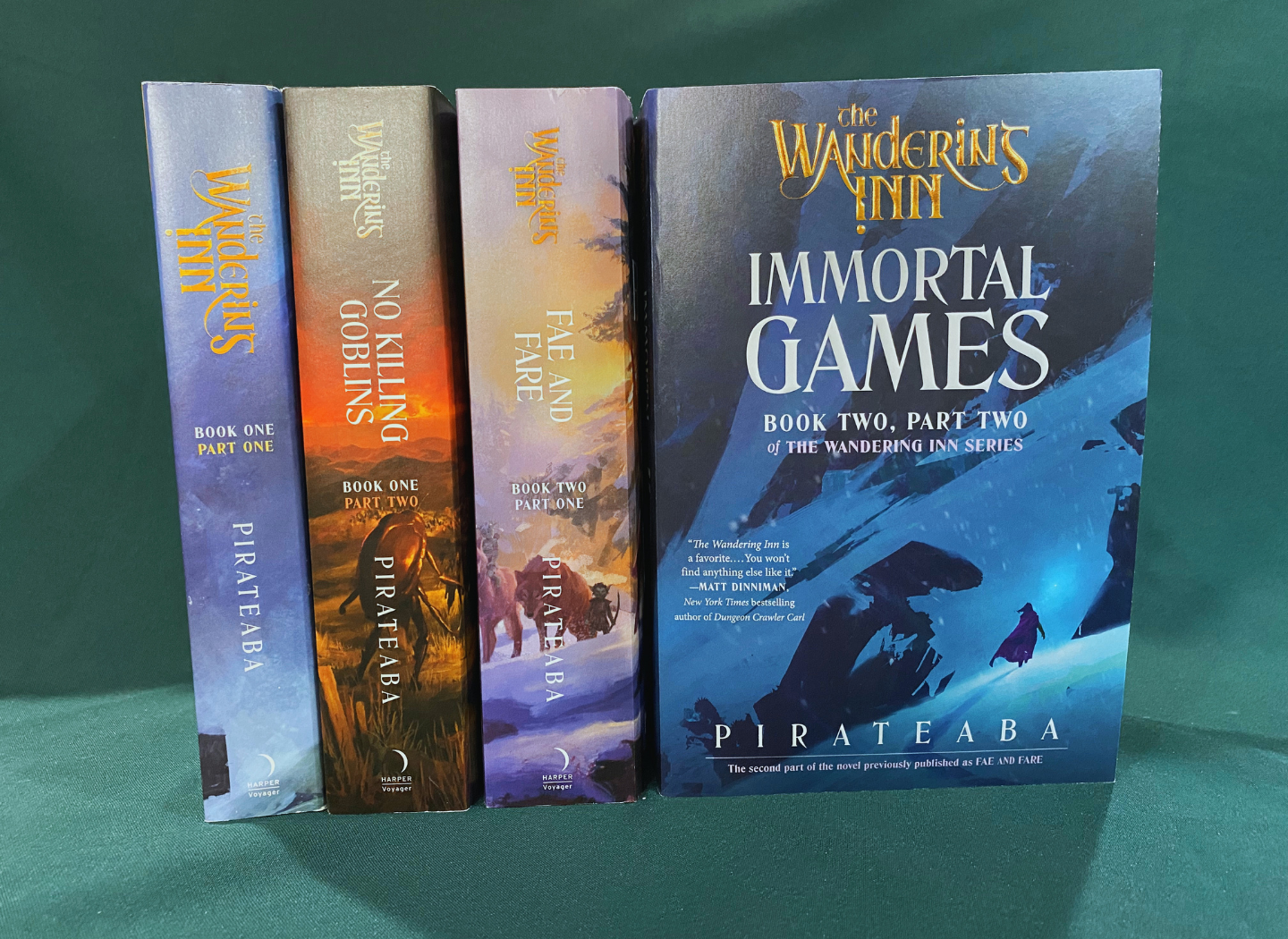
The fourth physical book, Immortal Games, will be in bookstores as of publishing this blog!
https://www.barnesandnoble.com/w/immortal-games-pirateaba/1149767082?ean=9780063516465
This is the final book of the launch and ordering one really helps make an impact that publishers and other groups can see. Every book counts and I appreciate the support everyone’s shown. I do want to talk about what it was like getting the books published, though. I may be light on some of the technical elements because it’s a process lots of authors talk about, but I do think it’s a bit interesting as far as this specific case goes:
So, how is publishing a physical book? Well…if you know anything about publishing books, from the sending of manuscripts, writing your own pitch, waiting—it’s as hard as I heard. I can confirm that myself.
I knew about the struggle to get books published—I tried to get two books published before The Wandering Inn, and never got past just submitting manuscripts. That’s an entire, entire process I can’t really recommend because it does feel like shouting into the void and there’s little feedback or motivation there.
To be clear, for The Wandering Inn, I got to skip that process in large. I had a finished work of a quality I was happy with, and an awesome agent who did all that shopping around to publishers, and I had a supportive audience which makes it so, so much easier to publish a story than being unknown.
The slush pile someone’s manuscripts get tossed into if they have nothing but their story? It’s the needle in a haystack and I got to pass that hurdle, but faced the one of web serials. Traditional publishers don’t like stories that already have a presence online, and TWI wasn’t a debut story, so there wasn’t a lot of enthusiasm (Dungeon Crawler Carl would have changed that a lot if I’d tried again now, it really has shifted the genre’s popularity. Matt has also been great about helping spotlight other writers in the genre, which deserves recognition for the effort he’s put in to help other authors. Including me!).
At the start when we were looking for people willing to publish The Wandering Inn, it was just a huge, long wait to have my agent talk to these big companies. There’s no immediacy like there is in self-publishing online. Even when we found people to talk to, the next step is a contract and that takes time.
Probably because TWI is a web serial and needed specific wording in the contract (like clauses I am not going to do book signings to preserve anonymity), the back-and-forth took months upon months of, well, waiting. I was just working while keeping this under-the-radar years ago, but when we finally got the contracts signed and it was happening? Then it got harder in a work sense.
You know I had to edit Volume 2, and I had some notes for Volume 1 as well. I had to pull time to do those edits and I’m experienced enough that it was just a really, really, really intensive several weeks that burnt me out a bit. You can probably even see my energy flagging or me talking in the Author’s Notes about how tired I am for some reason—that’s me pushing behind the scenes to get it done.
Even after that, there’s tons of little formatting I was doing with the company because a physical book has to look just right, so there’s fonts that need changing—I couldn’t have invistext on the books, and decisions to be made about the cover, Ryoka’s internal text fonts, all stuff that feels stressful because you have to commit to something and I didn’t always have the eye artistically to say ‘I know this is the right choice, let’s lock it in’.
Then came marketing, and shouting out the story. You remember the Inncentives campaign—coming up with rewards, organizing the tracker, and signing those books was huge. I still think flying out to go sign books for like 3 days straight was a weird fever dream, including getting stuck overnight in an airport.
It was such a journey that it’s only looking back that I realized how hard I pushed to get this all done. Not just me, but the team who was working in the background. I’ve been wondering why I have so much energy, now, and I realize it’s because the books are finally out.
I realize this all makes it sound so daunting, and tiring. I tend to focus on that kind of thing, and I’m probably good at conveying exhaustion, so like an Author’s Note, it paints a picture that’s not always accurate.
The reward for all this work was getting the books on shelves, and stopping in an airport and seeing my book in the stores. And seeing fans holding the books, and being excited and able to share that with other people as a real thing.
I’ve had friends go as far as Edinburgh, Scotland, and find the books in a store. I think it’s made a splash, and the books are still being sold in bookstores, week by week.
That matters. There is a sense, I have, that the act of creating a book is nearly impossible without doing this slow, and admittedly, very difficult process. I had a thought the other day.
What if I were just to get a printer, and try to print and bookbind my own story? If I never had worked with HarperCollins, I could have made a few books, maybe even as much as a hundred.
…But assume I did that. Could I format it properly? Get the right paper? Even if I could do that, I’d have a few custom books, but how would I ship it out? Spread the news?
This can only be done by a major company, or at the very least, someone with a printing press. Making a book appear in bookstores across the world is a magic trick that’s amazingly impressive. It’s not just because it looks nice, or that it’s physical, either.
I’ve said it before, but there are so many people who are willing to start reading The Wandering Inn when they have the physical book, who just don’t want to read it online.
My aunt, for instance, read through the story on her couch, and she likes me and has known of the story for ages. It’s just that she could sit there and read it, and that makes all the difference. Plenty of people do treat physical books as the real way to consume stories.
Yet it’s not even just that. I grew up with the internet. I’ve gone from it being a place filled with static websites and weaker search engines where you manually typed addresses into your HTML bar, to being connected by Google, allowing you to find so many things conveniently and quickly.
From disparate, floating islands made by enthusiastic people online, the internet became cohesive. Youtube is another great example of that; it went from a place with funny videos that the adults largely didn’t know about to being a place where people were forming audiences, good and bad, and creating unique things.
But in this era, it’s an actual job everyone knows about. It’s celebrity, and we have advertisements everywhere and Facebook went from a cool way to see friends from High School to being baked into your life.
For all that, I think the very same search engine that was once so useful and connected the internet has become a bit like a fat snake that poops out the top results and a lot of analytics or marketed links to you. It’s harder to find original content because everything’s driven by the algorithm.
I say this not to complain about the internet, but to say that in a strange way, it’s harder to find unique, interesting sites again. The internet is ever-expanding, a great sea of data, but at times it doesn’t feel like a sea of good and bad, predators and interesting things, but just a void of trash, clones of the most popular thing. It is hard for people to find things in it, and AI has only made it worse. I’m lucky that I have a website and an audience that pushes TWI to the top of search results and people talk about the story.
However, ironically, that means that it’s actually easier to fill the physical world of Earth with books and get attention there. After all, libraries, bookstores, these are places where you have an easier time of being seen. It’s just a reflection I’ve had of late.
What is the value of a physical book? I’d put it like this:
Long before I had a computer or phone I was on all the time, I read books in middle school and high school. Back then, I didn’t talk to people and say ‘what’s your favorite book’? I just went out and read books, good and bad, and the ones that captured me I read over and over again, and searched for more in the same series. I didn’t even search by author. I just read fantasy.
How did I find these books? Well, a library, of course. There was a library at my school with a surprisingly robust fantasy and science-fiction section, and I could get in after-hours because my mother was friends with the librarians.
So I’d just wander the shelves, looking for any books that caught my eye. I sorted by title, by cool covers. By what a librarian decided to display, and of course, the book jackets or summaries.
No recommendations, no top lists. I found lots of books I didn’t like, and there was no understanding from me who was new, or even popular.
Some books came from authors long dead. Others were contemporaneous, but I didn’t know that. Aside from the creasing of the books, the gloss of a new one, they were just books. But that’s how a kid with no money to spend found them.
That, to me, is the immortality that writers look for. To be so loved, or even, thought of well enough that a hundred years after you’re gone, some kid can wander into a library and find a book that was donated, or which a librarian thought they should keep around. Even now, that’s what I think is so valuable about all this effort.
So yes, it is worth it. And that’s just me looking to the future. Someday, I hope I’ll see someone reading The Wandering Inn in public.
To do that I do have to go out of my house a bit more, but I’m looking forwards to that moment. Immortal Games is out, and I hope that you’re still willing to buy it and put it on your shelves. I’d still like to hit that New York Times bestseller’s list, and the first week of sales is the most important one as it’s the one used for rankings.
If it’s feasible for you to get one, I hope my story ends up on your shelves, and not just the first four in the series. More books, and yes, someday, there might be so many they make a shelf groan and a librarian has to devote an entire bookshelf to The Wandering Inn. Who knows, they might not go for that, but I hope that first book appears in libraries and if a new reader finds that, they can find the rest.
Not just my own, this feels like a big month for LitRPG and web serials. Casualfarmer, Shirtaloon, Matt Dinniman, RinoZ, Tao Wong, Erin Ampersand—I know and have spoken to a lot of these authors and seeing all of us get book releases makes me think someday there will be a whole section in libraries marked web serials, just like there are for comics that came from the web.
I’d like that. It’d feel like giving back to all those stories I owe a debt of gratitude to growing up.
Thanks for reading,
—pirateaba
Links for Immortal Games:
North America:
https://www.booksamillion.com/p/Immortal-Games/Pirateaba/9780063516465
https://www.barnesandnoble.com/w/immortal-games-pirateaba/1149767082?ean=9780063516465
Europe:
https://www.waterstones.com/book/immortal-games/pirateaba/9780008836320